

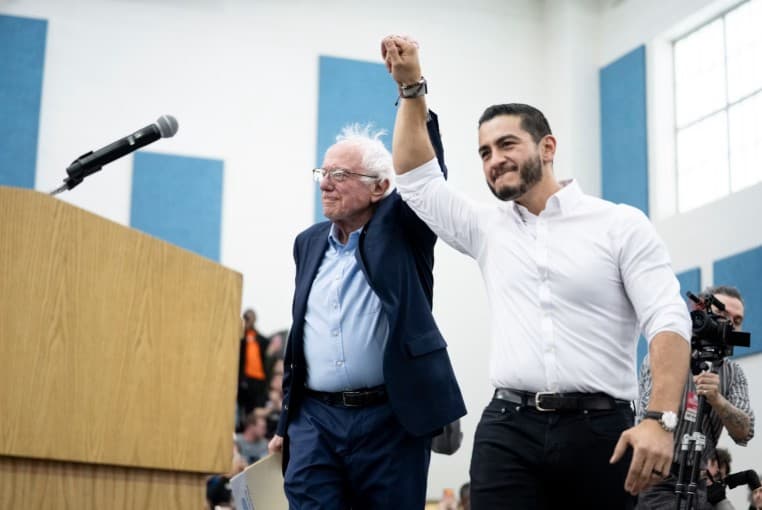
The process that began in Michigan politics with Democratic Senator Gary Peters’ announcement that he would not seek a third term has transformed the race for the Senate seat in the state from a routine election into a crossroads for the Democrats. The resulting situation led to the long-simmering ideological and strategic divisions within the Democratic Party erupting into open competition. At the center of the race were Congresswoman Haley Stevens, backed by the party elite and the establishment, and Dr. Abdul El-Sayed, one of the rising stars of the progressive movement.
El-Sayed, a Muslim doctor of Egyptian origin, has resonated strongly with young, dynamic Arab-American voters—a significant demographic in Michigan—through his clear criticism of the humanitarian crisis in Gaza and U.S. policies toward Israel. In fact, El-Sayed is not a new player in Michigan politics. He had also run in the 2018 gubernatorial primary but was defeated. Rather than withdrawing from politics after his defeat, El-Sayed focused on grassroots organizing and promoted his campaign—which lacked a traditional television advertising budget—through podcasts, digital broadcasts, and alternative media. Just as in the case of New York’s socialist mayor, Zohran Mamdani, El-Sayed’s campaign—which involved over 110city visits and a volunteer network that knocked on over 10,000 doors and included more than 10,000 people, he overcame the mainstream media’s initial limited interest and helped usher in a new era in American politics.
Moreover, this model was put to the test against a financial asymmetry rarely seen in American political history: While El-Sayed completely rejected corporate donations and ran her campaign on individual donations averaging just $28, his opponent, Haley Stevens, was backed by a massive financial war chest of over $30 million provided by Super PACs such as AIPAC and the United Democracy Project, and continued her campaign. Bernie Sanders and Alexandria Ocasio-Cortez, leading representatives of the progressive wing of the Democratic Party who take a critical stance toward the Israeli government’s policies and unconditional U.S. support-Cortez, who are critical of the Israeli government’s policies and unconditional U.S. support, also sided with El-Sayed during this election process, playing a major role in making organized grassroots politics more visible in the face of the power of corporate capital.
As a result, El-Sayed, who won the party’s primary, has only one general election left to secure his seat in the Senate. Following this upset victory in a swing state like Michigan, all eyes are now on El-Sayed. While this process demonstrates that the Democratic Party can expand not only by relying on corporate funding but also through its platform of radical economic equality, healthcare reform (“Medicare for All”), and social justice, it may also signal profound transformations in the future of the Democratic Party ahead of the 2028 presidential election.
Yorumlar yükleniyor…